Learning to See

I would think my abilities as a wizard should be growing. I've added a bit of beard, let my hair grow longer, and it's all transitioning to white. I wear a distinctively odd hat. I constantly study obscure books and knowledge and believe my wisdom has improved. Yet my spell-casting ability . . .
Casting a spell is the act of speaking words that produce a magical result. Yet every time I try casting one--for instance, any of these . . .
"You need to get in the shower.""It's time to try to sleep.""Please empty the dishwasher.""Let's get your homework started before it gets any later.""That's enough screen time; walk away from the device."
. . . they seem entirely ineffective. My spells don't work. How will I ever achieve wizard status if I can't get my spells to work?
A little slice-of-life humor to ease into this post even though doesn't particularly introduce any of the meatier thoughts to follow.


Speaking of magical words, here is a list of words I particularly like.
Solivagant - a solitary wandererSolvitur Ambulando - it is solved by walkingPeregrinatio - a journey made for its own sakeSine Die - with no fixed day of returnNuminous - the feeling that something greater is presentSelcouth - strange and beautiful at onceSaunter - to walk as if the ground were holyHierophany - the sacred showing through an ordinary thingHesychia - the stillness you walk intoKomorebi - sunlight scattered through leavesPsithurism - the sound of wind in the treesWaldeinsamkeit - the feeling of being alone in the woodsShinrin Yoku - to walk in the woods for no other reasonNemophilist - a lover of the forestWuthering - the noise wind makes on an open hillSusurrus - the sound of wind moving over grassYugen - a beauty too deep to put into wordsFestina Lente - make haste slowlyGradatim - step by step and no fasterFernweh - the ache for places you have never beenGenius Loci - the spirit of a placeThe Offing - the far water you can see but never reachNephophile - a lover of cloudsPetrichor - the smell of rain on dry earthBrontide - a storm too far off to hear properlyCeraunophile - a lover of thunder and lightningNubivagant - a wanderer among the cloudsSmirr - rain you feel before you see itSirimiri - rain that soaks you without ever fallingSnell - a wind cold enough to hurtNithered - cold enough to stop your hands workingApricity - the warmth of the sun in winterZephyr - the first warm wind of the yearVagrant - a bird a very long way from homeOrnithophile - a lover of birdsMontivagant - a wanderer in the mountainsOrophile - a lover of the mountainsGipfelgluck - the happiness that only arrives at the topFjellvant - at home in the mountainsGloaming - the last of the lightBlatimen - the blue hour after the sun has goneSelenophile - a lover of the moonHaar - the cold fog that comes in off the seaThalassophile - a lover of the seaKairos - the one right movementHodophile - a lover of roadsFriluftsliv - a life lived outdoorsHiraeth - a longing for a home you cannot return toSolastalgia - grief for a place that is changingSmultronstalle - your own secret good placeEucatastrophe - the sudden turn where it comes rightHalcyon - the calm after the stormMemento Vivere - remember to liveAmor Fati - love what happensUltreia - onwards; the pilgrim's greeting
With credit owed to the t-shirts of AukCliff clothing.


One more thing to help set the mood before I shift to our real topics.
Directly beneath our feet stretches a world both smaller and much, much larger than the one we know. Scientists have just begun mapping what may well be the largest piece of infrastructure on Earth: a network of fungal threads that is 68 quadrillion miles long. . . .This network is larger than every road, cable, and shipping lane combined. And it’s alive. . . .Think of these relationships, also known as mycorrhizae, not so much as tender friendships, but as shrewd trade agreements: Both parties get something indispensable out of it. The plant can make sugar from sunlight, but is bad at foraging. So the fungus provides phosphorus, nitrogen, and water. The fungus is a foraging superhero, but cannot photosynthesize. So the plant repays the fungus in carbon. . . .In total, it is estimated to weigh around 300 million tons, which, the authors write, is roughly five times the biomass of all humans on Earth combined. . . .The fungal network moves around four billion tons of carbon dioxide equivalent into the soil each year. That is equivalent to 11% of humanity’s annual emissions. . . .The map points to grasslands as the hotbed of fungal filaments — as much as 40% of the world’s arbuscular mycorrhizal network is buried beneath the waving fields of grass of the Tibetan Plateau, and the flooded grasslands of the Everglades and South Sudan, among other places. . . .The main thing this map can and should do, is change the way we think about the ground beneath our feet, a worthy enough task as it is. Land that looks empty may well be teeming with life, albeit right under the surface. Soil is not just the solid foundation of our world, but itself a layer filled with living creatures — just not how most of us think living creatures look like.
The world is so much more than we can ever know.

A thought I had the other day:
Vampires, according to legend, have no images in mirrors and other reflective surfaces. Vampires have no reflection. Which means that a vampire can never see their own appearance. They can't see how they are perceived by others--and, one assumes, this extends to an inability to see the impact they have on others. The most significant representation of a parasite in our collective imaginations is blissfully unaware of itself and the harm it causes. This implies a shared belief that the parasitic among us rely on blindness to their harmful natures and that improvement lies in their gaining more awareness of self and others.
An incomplete thought, but I weave it into a much longer one at the end of this post--after we travel through a plethora of interesting things I've read recently.

Directly related to my vampiric thoughts, from my feed on Facebook.
Predatory identity is Arjun Appadurai’s concept for explaining how an identity becomes exclusionary when another group is constructed as an existential threat. In Fear of Small Numbers, he examines how tensions between majorities and minorities can transform ordinary differences into political fears. The minority is no longer seen simply as different; it is portrayed as an obstacle to the majority’s desire for a complete, unified national identity.The crucial movement is from difference to threat, fear to mobilization, and mobilization to exclusion or violence. Predatory identity therefore emerges when coexistence is replaced by the belief that “we” can survive only if “they” are subordinated, removed, or made to disappear. For Appadurai, the danger lies not in diversity itself, but in the political production of difference as an existential threat.That text introduced the following image:PREDATORY IDENTITYPredatory identity refers to a form of collective identity whose construction and survival are perceived to require the exclusion, subordination, expulsion, or elimination of another social group.In Fear of Small Numbers, Appadurai uses the concept to explain how majoritarian anxiety, especially the fear of an "incomplete" national or cultural identity, can transform minorities from simply being different into perceived threats.Predatory identities therefore emerge when difference is reinterpreted as danger and coexistence as impossible, making exclusion or violence appear necessary for the imagined security and completeness of the dominant group.The concept is closely associated with the relationship between numerical majorities and vulnerable minorities, particularly under conditions of social and political uncertainty. Appadurai argues that the minority may become a symbolic site onto which wider anxieties are projected, allowing complex insecurities to be expressed through hostility toward a proximate group.In this process, the protection of collective identity can be presented as requiring the removal or control of the perceived threat, transforming identity politics into a logic of exclusion.

Identities can be parasitic, particularly those based on privilege.


A character-driven story with a propulsive plot, sharp social commentary, and humor.
Seven years ago, retired journalist Rhys lost it with with his conspiracy-obsessed, fundamentalist Christian, right-wing son-in-law. Disillusioned, fed up with society's ills, and told by his only daughter to go away, he tossed his cell phone out his car window and withdrew to the old cabin in remote Washington that he'd inherited, spontaneously deciding to live a solitary existence off the grid. Now, his two grandchildren are standing on his porch asking for help since their dad has moved even further to the fringes in a Christian militia compound and their mom has disappeared. Rhys suddenly has to figure out how to interact with people again and navigate modern life while pursuing the dual goals of finding his daughter and keeping the kids safe from their father and his militant friends.
It's a delving exploration of our deep cultural divide that drives people further to the edges and a moving exploration of human bonds and connections--displaying the complexity of human natures, how we can be scared, desperate, ugly, and hurtful at the same time that we are yearning, loving, warm, and funny; bad and good in equal amounts. And it manages all this while being marvelously entertaining.
Some thoughts from the book I pulled out for reflection:
But I’m starting to think Thoreau might have been full of shit. If we aren’t living for others, maybe we aren’t really living.-----We all have to live through a dark season now and then.-----It was possible to disappear from others' lives, of course – from Lucy's, from Bethany's – but he suspected that when he woke up tomorrow, wherever he was, the person he really wanted to never see again would be staring right back in the mirror. 'Maybe don't get a mirror', he thought, and this made him smile.-----As a journalist, as an American, as a rationalist, Kinnick had come to terms with the fact that 20 percent of his countrymen were greedy assholes. But then, in 2016, the greedy assholes joined with the idiot assholes and the paranoid assholes in what turned out to be an unbeatable constituency, Kinnick realizing that the asshole ceiling was much higher than he’d thought, perhaps half the country. Whatever the number, it was more than he could bear. Especially when they were in his own family.-----It was one of the hardest adjustments for Kinnick, owning a cell phone again. It was like a nosy neighbor with a constant supply of scary news, a pocketful of drip-drip dread and festering fear. He was glad to be able to call Bethany, but the thing was a constant delivery system for terrifying developments from all over the country, from around an overheated, overpopulated planet. Technology, as he saw it, had finally succeeded in shrinking the globe, so much so that every news story felt dangerous and personal, every war a threat to his family, every firestorm, hurricane, and melting ice cap a local disaster, the seas boiling up around them, every cynical political and legal maneuver part of the same rotten fabric--and half the country somehow seeing it exactly the opposite way.
Many themes here that tie into the essays and articles in this post.
When he woke up tomorrow, wherever he was, the person he really wanted to never see again would be staring right back in the mirror. 'Maybe don't get a mirror', he thought.
It was like a nosy neighbor with a constant supply of scary news, a pocketful of drip-drip dread and festering fear.


Reality can be stranger than fiction.
“You’re not gonna believe this shit,” a friend texted her, and then sent the first of several videos posted by a man who introduced himself as Mike Brewer, the leader of an “apostolic hub” called the Well. Sitting at a desk, he explained in a calm and methodical manner that the bookstore had been identified as a “regional demonic stronghold.” A high-ranking demon named Lilith was involved, Misosky would learn, and the bookstore was being targeted for something called “strategic-level spiritual warfare,” the goal of which was to “remove the enemy.”Misosky had been born and raised in Maryville. She was 58, Catholic, and gay, and told me she was used to living among conservative Christians. Still, demonic came as a surprise. “This is probably the dumbest thing I’ve ever heard,” she remembered thinking after seeing the first video, not yet realizing that the church was part of the fastest-growing segment of Christianity in the country, or that the language she was hearing in the fall of 2022 was spreading across the Christian right and the wider political landscape. . . .She began searching for books on the subject, learning of an entire specialty called demonology. She found a manual written by an East Texas couple called Pigs in the Parlor: A Practical Guide to Deliverance, which had a chapter outlining 53 different demonic groupings. . . .They believed that being a Christian meant being in a constant state of spiritual warfare.In its most basic form, this simply meant praying for God to eradicate evil. But NAR leaders pioneered a more radical version that they called “strategic spiritual warfare,” which entailed the idea that demons could take over cities and institutions, and that Christians could target and scatter them by their physical presence, intensive prayer, singing, marching, and other strategies. . . .“It was obvious,” Andrea said. The high-ranking demon influencing the region was Lilith, a Mesopotamian wind goddess who ruled over forbidden sexual desire, and Southland was the stronghold, which Mike defined as a place where certain thoughts, attitudes, and behaviors contrary to God were flourishing. Mike informed the church elders. “I said, ‘We cannot just let this stuff go,’” he told me. “I said, ‘This is evil.’” . . .Then, a few days before the fundraiser, in November 2022, Mike and Misosky spoke by phone.Her recollection is that she called Mike, and that he talked about doing spiritual warfare against voodoo chiefs in Haiti, and that she said, “That’s great, Mike. Why don’t you have a cup of coffee with me?”Mike’s recollection is that he called Misosky. “I said, ‘I’m not calling to resolve differences. We’re not going to do that. I am calling to request that you go 18 and older for events,’” he said. “ ‘If you’re marketing to children of this area, we’re going to do everything within the law and the spirit to stop you. We will never harm you physically.’ I said, ‘I’m calling out of respect.’”And that was the last time they spoke. . . .Until recently, all of this might have been considered a dispatch from the fringes of American religion, except that the ideas taking hold in Maryville are becoming more and more mainstream. . . .The next evening, she stood with dozens of supporters in front of the bookstore, watching as a group of nine men, some with their faces covered with bandannas, marched down a side street and up to the sidewalk in front of the entrance, where police stopped them from going any farther. According to local press reports, the men held signs that read GROOMERS ARE PEDOPHILES and IT’S OK TO BE WHITE. At least one of them appeared to have a gun. . . .In front of Southland, there was shouting back and forth between the protesters and Misosky’s supporters, and after a few hours, the masked men returned to their cars, which were parked several blocks away; some of them reported to the police that their tires had been slashed. . . .In a more immediate sense, invoking demons can be a means of dehumanizing and delegitimizing political enemies, which has often been a precursor to actual warfare and political violence. “It’s a very useful way to get around the Christian imperative to love your enemy,” Matthew Taylor, a visiting scholar at the Center on Faith and Justice at Georgetown University, told me. “For the most part, that is the ironclad command. So how do you get Christians to hate their enemies? Or to hate them even if they love them? Demons are easy to hate. They are irredeemable objects of hatred.”
Predatory identity refers to a form of collective identity whose construction and survival are perceived to require the exclusion, subordination, expulsion, or elimination of another social group.


It was like a nosy neighbor with a constant supply of scary news, a pocketful of drip-drip dread and festering fear.
We keep marveling at how fast the years go by. The deeper problem is that we’re forgetting them — and losing the quiet, boring moments where memory forms.Our perception of time isn’t based on any fixed sense of duration. We do not, in fact, have an internal clock measuring minutes, hours and days. Instead, we use our external environment as a proxy for the passage of time. The more “stuff” our sensory cortex is picking up on, the more time we register as passing.This new way of looking at time perception could shed light on why so many people feel like time is speeding up today. We’re inundated with videos, images, notifications and a cavalcade of content 24 hours a day, forcing our brains to contend with far more information than they needed to 10 or 20 years ago. . . .When we’re flooded with text, images and glowing blue light, our brains are tricked into speeding up the internal proxy mechanisms they use for measuring time. As a result, time feels like it’s moving faster and faster. . . .Retrospective time perception is even more subjective than other forms of time judgment, given its outsized dependence on “things which are novel or exciting or scary or have some visceral meaning to them.” The memories that stem from those stimuli are our footprints in the snow, giving our past the solidity and verisimilitude that would otherwise blow away in the past’s enveloping whiteout.Our memories are the key to the central irony of our supersaturated world. Roseboom’s theory posits that time spent in an environment overflowing with visual information should feel long and robust. “You would think that because we’re paying more attention to more things, that retrospectively time should feel longer,” Jones noted. “But I think we’ve got the worst of all worlds.” Because while we encounter a glittering constellation of apps, games and videos beckoning us at every turn, eager to light up our sensory cortex, they’re not generating the indelible experiences crucial to forming memories. “When you get to the end of the day, you look back and there’s no meaningful content there. It’s just the same blur, the same stuff, and there’s nothing distinctive about it.” . . .Social media platforms are uniquely effective at short-circuiting our retrospective time perception. After spending time on these apps, the abstract field our mind’s eye draws from to make sense of recent experiences is left barren, devoid of the evocative wisps we integrate into the hazy memory palace that ultimately serves as our past. Instead, many of us are now confined to a permanent amnesiac present, one throbbing with artificial life but unable to fathom where it came from or where it’s going. . . .Technology should be seen as the sole culprit for our warped perceptions of time. . . . In TIMED’s interviews, respondents also told Ogden and her colleagues they were uncomfortable with periods of inactivity and felt compelled to use their devices to fill every available gap in their schedule. “What we found through TIMED is that even when people have time, they don’t use it to do nothing,” she told me. “We live in a society that really values constantly being busy and constantly having something to do." . . .If people were more comfortable with intervals that lacked so-called productivity — quiet longueurs, spells of boredom or periods of aimless reflection — they might stand a better chance of expanding and enriching the way they experience time. “It’s in those calm moments where we see a unique pattern of activity in the part of our brain responsible for helping to make our memories,” Hyman said. Those still, empty stretches are when we contemplate our immediate pasts, integrating them into the larger arc of our lives. . . .In Ogden’s eyes, the dilemma hinges on a simple question: “How do we get people back to being comfortable with doing very little and believing that doing little is not an indication of laziness?” . . .Western culture views time as a currency to be leveraged, channeled and optimized. The societal pressure to perform productivity at all times is so insistent and thrumming that many of us — myself included — have lost the ability to slow down and luxuriate in the inherent slowness of time . . .Maybe the crisis of time speeding up is not as hopelessly irreversible as it often seems. According to the latest time perception research, the amount of information our brains engage with shapes our subjective sense of how fast time is moving. If we intentionally reduce the stimuli we’re exposing ourselves to in a given day or week, then our brains will gradually slow down. And if our brains slow down, then our perception of time will taper off, too. . . .We need to change the culture surrounding how we spend our time. That means coming to terms with the reality that boredom and “doing nothing” are neither shameful nor necessary evils.
We don't need to be like Rhys at his most extreme, but it's good to moderate our reliance on our technologies.


An additional perspective on moderating ourselves:
. . . a psychological phenomenon you could call the future-self fallacy. Studies show that we tend to imagine our future selves as having more time and capacity than we do today.And when we look at the future, we see the empty spaces in the calendar, but not the requests, delays, problems and new commitments that will eventually fill them.Another reason this fallacy is so prevalent is that it gives our stress a finite horizon. While “I have to live like this indefinitely” would be frightening, “I just need to make it until next Friday” feels manageable.That’s how we end up turning chronic overload into a series of what we think are temporary sprints, and we keep borrowing from our future capacity. So how do we break the cycle?1. Start treating exhaustion as a signal. We tend to treat exhaustion as an exception, assuming the problem is this particular month, rather than information we can use to take action. If you have been saying “just one more week” for six weeks, something about the system needs to change.2. Plan for your real future self. Assume that next week you will have roughly the same energy, distractions and unexpected problems you have today, and leave room accordingly. Timeshielding is my favorite way to do this.3. Stop postponing life itself. Rest, exercise, friends, reading, thinking… Do not get these things scheduled for the mythical quieter month ahead. Make space for the parts of your life that matter to you right now, whether that’s a good book, a long walk, or a coffee chat.There will always be unusually busy periods, and sometimes we really do need to push through. But the most important thing we can do for our future self is not believe they will magically cope with more.
Limits are not only good, they're necessary.

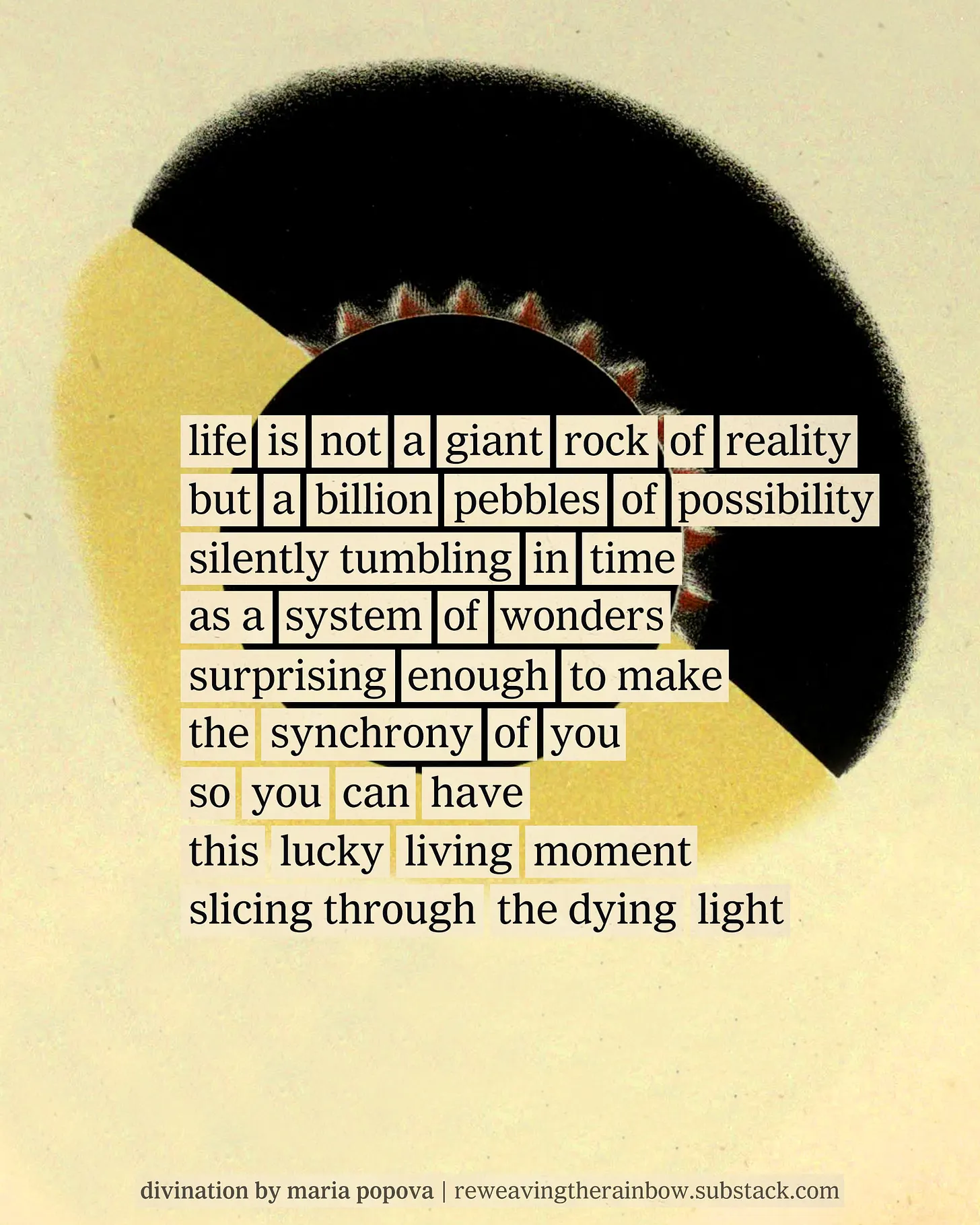
life is not a giant rock of realitybut a billion pebbles of possibilitysilently tumbling in timeas a system of wonderssurprising enough to makethe synchrony of youso you can havethis lucky living momentslicing through the dying light
Life is a billion pebbles of wondrous possibility.
-----
Also from Maria Popova:
Nothing, not one thing, hurts us more — or causes us to hurt others more — than our certainties. The stories we tell ourselves about the world and the foregone conclusions with which we cork the fount of possibility are the supreme downfall of our consciousness. They are also the inevitable cost of survival, of navigating a vast and complex reality most of which remains forever beyond our control and comprehension. And yet in our effort to parse the world, we sever ourselves from the full range of its beauty, tensing against the tenderness of life. . . .Saunders examines the elemental impulse for storytelling as the basic organizing principle by which we govern our lives:The instant we wake the story begins: “Here I am. In my bed. Hard worker, good dad, decent husband, a guy who always tries his best. Jeez, my back hurts. Probably from the stupid gym.”And just like that, with our thoughts, the world gets made.Or, anyway, a world gets made.This world-making via thinking is natural, sane, Darwinian: we do it to survive. Is there harm in it? Well, yes, because we think in the same way that we hear or see: within a narrow, survival-enhancing range. We don’t see or hear all that might be seen or heard but only that which is helpful for us to see and hear. Our thoughts are similarly restricted and have a similarly narrow purpose: to help the thinker thrive.All of this limited thinking has an unfortunate by-product: ego. Who is trying to survive? “I” am. The mind takes a vast unitary wholeness (the universe), selects one tiny segment of it (me), and starts narrating from that point of view. Just like that, that entity (George!) becomes real, and he is (surprise, surprise) located at the exact center of the universe, and everything is happening in his movie, so to speak; it is all, somehow, both for and about him. In this way, moral judgment arises: what is good for George is… good. What is bad for him is bad. (The bear is neither good nor bad until, looking hungry, it starts walking toward George.)So, in every instant, a delusional gulf gets created between things as we think they are and things as they actually are. Off we go, mistaking the world we’ve made with our thoughts for the real world. Evil and dysfunction (or at least obnoxiousness) occur in proportion to how solidly a person believes that his projections are correct and energetically acts upon them.Over time, our stories harden into certainties that collide with each other every time we engage with another person, who is another story — another embodiment of the unreliable first-person narration . . .Trying to communicate across this fissure of understanding yields results sometimes comical and sometimes tragic, always affirming that reality is not singular but plural, not a point of view but a plane of possible vantages. . . .In a world full of people who seem to know everything, passionately, based on little (often slanted) information, where certainty is often mistaken for power, what a relief it is to be in the company of someone confident enough to stay unsure (that is, perpetually curious). . . .This openness to more — to truth beyond story, to beauty beyond certainty — is precisely what teaches us how to love the world more.
The stories we tell ourselves, the stories that shape our certainties and identities, can too easily be predatory and parasitic.


Rhys found benefits to escaping into solitude, but he ultimately had to accept that it did not make him happy.
There is a social cost to many modern conveniences.When showing up for others feels hard, some strugglers have lately steeled themselves with a version of this maxim: “Inconvenience is the cost of community.” It’s a reminder, oft-repeated on social media these days, that if you don’t want to be lonely—if you want to have robust relationships—you should occasionally do things that are effortful or even irritating, like cat sitting for a neighbor (or even just conversing with one!). You must give up on always pursuing maximum ease.The inverse of this adage is also true: Community is, all too often, the cost of convenience.In the journalist Gabe Bullard’s new book, Against Convenience, he argues that society’s relentless pursuit of faster and more frictionless experiences carries invisible costs, and he pushes back against how unthinkingly people often accept those costs as inevitable. Some of those costs are paid in dollars, as with monthly subscription fees to Netflix rather than the onetime cost of buying a DVD. Some are paid in lowered standards: more easily accessible entertainment that’s of poorer quality (YouTube shorts, anyone?), “smart” products that become obsolete faster than their analog forebears. But in reading the book, I noticed just how many of those costs are social. . . .Talking with strangers brings a lot of benefits. Research has found that it’s mood boosting, and often more informative than people expect. One study, called “Mistakenly Seeking Solitude,” found that people regularly and incorrectly assume that being alone will make them feel better than interacting with another person.Avoiding these kinds of interactions is a detriment not only to yourself but also to the society you’re part of. It is often the so-called weak ties in someone’s network—the neighbor down the block you know only casually, the barista you order a latte from once a week—who are the most important in creating a rich sense of community. Because your networks overlap only a little, your weak ties can be a bridge to new connections, or they may know about job openings and social events that you and your close ties wouldn’t have come across on your own. Without weak ties, we wouldn’t have communities, just insular cliques. . . .Individual conveniences add up to a deterioration of the public sphere. . . .When it comes to the social costs of convenience, individual actions can easily bring collective comforts. Taking out your headphones to say hello to a neighbor, scheduling dinner with friends instead of ordering delivery again—these choices pay immediate dividends in the form of connection, while also being a deposit in the shared, slower-yield investment account of building lasting community.
We are inherently social, meant to be in relationship with others and parts of communities. Creating identities that are more social and relational, that build community, is essential to our well-being.


We are more able to find our social natures when we slow down.
Why we need wonderThis culture of optimization has been building for some time now, since at least the 19th century, when industrialism made efficiency a core ideal of working life. . . . This optimization mindset leaked out of business and into everything else. People stopped asking what activities were for and started asking how to do them better, faster, or more completely.Efficiency now infuses every aspect of contemporary life, if you let it. . . . Every pleasure can become instrumental—with every instrument focused on the outcomes it might produce.Optimization is terrific if you want to get somewhere else in the future. But it’s terrible for being where you actually are right now. When goals overtake experience, you lose the freedom to encounter your life as it happens. And when you lose that ability, you are no longer living in full. We used to optimize work so we could do everything else. Now we optimize life as though living were another job. Too many of us seem to be maxxing our way out of the experiences and perspectives that give us maximum meaning. . . .For many adults, wonder is too often compartmentalized: a feeling we associate with extraordinary and rare experiences, banished to a realm outside the mundanities of daily life. . . .Efficiency culture has muscled out the present so completely that it feels difficult to occupy a moment at all, let alone fully. . . . Wonder interrupts that impulse to rush to the future before it arrives. It makes the world stop serving our self-centered plans or intentions, and instead offer something worth encountering for its own sake. . . .I realized that I felt best able to overcome efficiency culture when I treated supposedly unimportant sensations, objects, and events as vital ones instead: sliding my feet into the plush softness of slippers in the morning, feeling the warmth of a mug of coffee in my hands, hearing the gravel crunch under my feet as I walked. None of these acts compromised purpose or plans. All they required of me was to construe what I was already doing as valuable.Eventually I came to recognize that my long-standing obsession with ordinary things—including many that I have written about in The Atlantic, among them toasters, gas-station signs, backpacks, slushies, and gearshifts—offered a reason to take the present seriously. These objects show that beauty and even genius are often expressed through design choices and simple engineering. Tools we might think of as “useful” are in fact wondrous. . . . The route I am suggesting does not require an out-of-the-way trip. It simply asks you to accept gifts that the universe is already handing you.Wonder may not improve your résumé, make you hotter, or maximize your income. It will simply remind you that you are a body alive in the world, right now, and that is a better place to begin than most self-help advice would have you believe. . . .Whenever you cease treating the world as scenery or equipment, you’ll find that you encounter the world as something inexhaustibly, constantly present. Oceans and ants, sewing machines and sunsets, strangers and screen doors, microwaves and mountains, rocks and racquets, lamps and laughter all prove equally worthy. Our expectations for wonder sometimes wane, but it is with us all along, waiting to be rediscovered.
Wonder comes from feeling connected to others and the world, to knowing we are part of something greater.


Recently, my library system's Voices of Inclusion, Belonging, and Equity team put out a call for contributions to our content, and in response I shared with them what follows. Some of it--or versions of it--has previously appeared in other posts on this blog.
Learning to See Privilege
A quote I’m fond of:
People in brightly lit places cannot see into the dark.
That’s from Marie Rutkoski’s book The Winner's Curse. While the quote is literal in the context of the book--a character is looking into a house from outside at night, knowing he doesn't have to worry about being seen because of the lighting dynamics--it is possible to read a deeper meaning into it based on the characters' situations: a slave is looking in at his owner. I interpreted the sentence as metaphorical as well as literal.
I think it is an eloquent metaphorical statement on the dynamics of privilege. Those with the privilege of being in brightly lit places cannot see into the darkness of those who are disadvantaged in contrast. Their privilege, by its very nature, blinds them to the impact of that privilege on others, and they are hard-pressed to understand what life is like for those without that privilege.
Their situations prevent them from seeing that their perspective is not the only one, that there's an entire world of experiences outside their own on the other side of the window that they consider only a mirror. They’re unaware that those on the dark other side of the window often have a much clearer, more complete understanding of social power dynamics and reality than they do.
Speaking of mirrors, vampires, according to legend, have no images in mirrors and other reflective surfaces. Vampires have no reflections. Which means that vampires can never see their own appearances. They can't see how they are perceived from the outside by others--and, one assumes, this extends to an inability to see the impact they have on others. The most significant representation of a parasite in our collective imaginations is blissfully unaware of itself and the harm it causes. This implies a shared belief that the parasitic among us rely on blindness to their harmful natures and that improvement lies in their gaining more awareness of self and others.
Another quote, from the book Pet by Akwaeke Emezi:
The first step to seeing is seeing that there are things you do not see.
I am a white male. I am heterosexual and cisgender. Educated, Protestant Christian, tall, able-bodied, and healthy. The list could go on. In nearly every category that can be identified, I am at the privileged end of the continuum. And I am on a life-long journey to better understand what that means. I was blind to it in the early part of my life until I started getting glimpses enough to help me realize there was so much that I did not see. I have been working to improve my sight ever since—and will never see as clearly as I should.
Growing up I felt bland. Nondescript. Normal. And that’s the trap of privilege, that those with privilege have the power to define for everyone what “normal” looks like. The “universal” person, the generic standard against which all others are measured, is the privileged one. Which means anyone who doesn’t fit in one category or another (often multiple) is the one considered “different.” The one with difference is the one who is not “normal.” We don’t see the people who fit the mold, we see the ones who don’t. We unconsciously, through our collective societal perspective, see those “others” as somehow deficient or wrong or lesser.
We don’t choose to have this perspective. Just as a fish is surrounded by water every second, we are surrounded by our environment, culture, language, and technology. Because these influences are constant and normal, we don't notice them. And it is difficult to analyze or question a system when you have never experienced anything outside of it, as those with the privilege of meeting the standards of "normal" don't. So, the privileged are unable to see the dynamics of privilege in the way that everyone else is.
Life is always a struggle full of obstacles; having privilege does not mean life is automatically easy. It simply means having fewer difficulties than others. I have never been sexually harassed, something most women experience. I often go walking in the woods or in urban environments or at night without fear, places many women don’t feel safe. I constantly see representations of myself in media and have never felt hostile eyes watching me as a potential shoplifter or troublemaker, as those with darker skin often do. It’s easy for me to feel trusted by others, safe, and like I belong. I have never been told my romantic and sexual desires make me incompatible with God. I don’t get excluded from job options. My opinion is automatically considered authoritative. On and on. I don’t get to escape working hard and earning my way, yet I have it so much easier than so many others.
And I’ve had to work to be able to see that, because the awareness was not automatic. There are elements and dynamics I am still, all the time, coming to see. The hardest part to see is that every time something is less difficult for me, it is more difficult for others. The societal perspective and structures that make me “normal” and “acceptable” cause others to suffer. Even if I never have a harmful thought or action, others are suffering because of the privileges I accept. That can be a difficult reality to come to grips with—and knowing how to help change it can be even harder.
For a number of years, I was a core member of the library’s Race Project KC initiative and was invited to serve on the community advisory board that guided its transition to the emerging independent nonprofit Raise Up KC. If asked to describe what that work entails, I sum it up as the work of sharing stories. It is about understanding the experiences of others, and it happens when we bring differences together to listen to and learn from each other. We create safe environments, earn the trust necessary to allow vulnerability, and tell our stories. We consume new stories together and share our reactions. We learn what it is like to experience the world from other perspectives. And, in coming to better understand others’ stories, we learn how to better respond to everyday situations in ways that are beneficial instead of harmful.
I have a very clear answer when asked for my “why,” why I am a librarian and why I work at Johnson County Library. I remember a moment in college when, after years of exploring, I finally realized I wanted to major in English. I had a natural inclination for science and math, enjoyed learning across disciplines in all areas, but what I really had a passion for was learning about the human condition through encounters with literature and stories. I wanted to find a career where I could do so and could share that journey with others. I’ve been working to do so ever since. The work of the library is sharing stories.
I opened this piece by considering reflections, windows, and mirrors. In the library we like to talk about how books function as windows and as mirrors.
A book that is a mirror is one that you see yourself in. It’s comfortable and familiar and it makes you feel seen. It validates you, because it is someone else sharing experiences you know and feelings you have, and in doing so affirming that you are not alone. It makes you feel connected to the story, to the storyteller, and to others who also recognize themselves in that book. It affirms and represents your values and worldview.
A book that is a window is one that helps you see outside of yourself. It relates experiences you’ve never known, feelings you’ve never dealt with, perspectives you’ve never considered. It takes you somewhere else, gives you an opportunity to know life as someone you’ve never been. It is about other people, those with different values, interests, and worldviews.
The more privilege a person has, the more responsibility they have to seek windows. Mirrors are everywhere and automatic for the privileged; the work is in dimming the lights enough that windows stop being reflective and start allowing us to see through them clearly. It’s all about learning to see.
-----
I want to quickly share an activity I developed as possible curriculum content for Race Project KC. I took the basic ideas developed by Peggy McIntosh in White Privilege: Unpacking the Invisible Knapsack and the popular privilege walk exercise and did my best to adapt them for high schoolers in a Zoom environment. It’s a good way to see the dynamics of privilege at play in relation to race.
Privilege Spotlight
Instructions to participants: Turn your cameras off and mute your microphones. I will read a series of prompts. If a prompt applies to you, turn your camera on. Pause and observe for 5-10 seconds. Then turn your camera off and wait for the next prompt.
Prompts:
- If you have never tried to change your appearance, mannerisms, or behavior to fit in at your school, please turn your camera on.
- If you have never been called a racial slur, please turn your camera on.
- If you have never been asked to explain a food, music, custom, or culture, please turn your camera on.
- If the authority figures in your life generally look like you, please turn your camera on.
- If your parents have never had a conversation with you about how your race will impact your life, please turn your camera on.
- If your household has employed help as tutors, nannies, gardeners, or housekeepers, please turn your camera on.
- If you can do well in a challenging situation without being called a credit to your race, please turn your camera on.
- If you can find Band-Aids at mainstream stores designed to blend in with or match your skin tone, please turn your camera on.
- If you have never worried someone might call the police because of something you—or a group you were a part of—were doing, please turn your camera on.
- If English is your first language, please turn your camera on.
- If you have never seen your heritage turned into a Halloween costume, please turn your camera on.
- If you have never seen your heritage turned into a sports mascot, please turn your camera on.
- If you have never used public transportation, please turn your camera on.
- If, when faced with the disapproval of others, you don’t worry that your race will be part of their disapproval, please turn your camera on.
- If characters in books are assumed to look like you unless otherwise noted, please turn your camera on.
- If no one has ever been curious about or asked about your hair, please turn your camera on.
- If you have never worried what new neighbors might think of you, please turn your camera on.
- If you have never been asked, “Where are you from?” please turn your camera on.
- If you have more than fifty books in your household, please turn your camera on.
- If you have never, while shopping alone, felt watched, suspected, followed, or harassed, please turn your camera on.
- If you see people who look like you widely represented as the norm on TV, news, and other media, please turn your camera on.
- If your family has lived in the US for at least 20 years, please turn your camera on.
- If you never think about whether your actions or appearance will reflect badly on your race, please turn your camera on.
- If you studied the history and culture of your ancestors in elementary or middle school, please turn your camera on.
- If your family owns their house, please turn your camera on.
- If you can display anger and aggression without others associating it with your race, please turn your camera on.
- If you would not think twice about calling the police when trouble occurs, please turn your camera on.
- If your entire family has health insurance (including Medicaid), please turn your camera on.
- If school and government holidays coincide with religious holidays that you celebrate, please turn your camera on.
- If you or your family ever inherited money or property, please turn your camera on.
- If your primary ethnic identity is "American," please turn your camera on.
- If you can swear, or dress in second-hand clothes, or use text or chat speak, without having people attribute those choices to the bad morals, the poverty, or the illiteracy of your race, please turn your camera on.
- If you feel no loss or liability knowing no language or culture besides your own, please turn your camera on.
- If you have never had to worry that you will be perceived as an authentic member of your ethnic group based on a sufficient amount of “blood,” as verified by a government-issued document, please turn your camera on.
- If a college education has been the norm in your family for at least three generations, please turn your camera on.
- If you have never been called a thug or a terrorist, please turn your camera on.
- If no one has ever been surprised at how articulate you are, please turn your camera on.
- If you have never skipped a meal because there was no food in the house, please turn your camera on.
- If you have been taken to art galleries, museums, and fine arts performances by your parents, please turn your camera on.
- If you can be late to a class, event, or gathering without having the lateness reflect on your race, please turn your camera on.
- If your online community is similar to your real-life community, please turn your camera on.
- If you never really think about your race (except in situations where race is the topic), please turn your camera on.
- If others identify you as white, please turn your camera on.
- If you have not yet turned your camera on in response to a prompt, please turn your camera on.
Discussion questions:
- How are you feeling?
- What did you see during this activity?
- What went through your mind as you turned your camera on and off?
- Which of the statements did you find most meaningful or eye opening? Why?
- Which of the statements, if any, hurt? Why?
- In what ways do the people on screen right now reflect or not reflect your community?
- What does this activity say about societal messages about your worth and the worth of people like you?
- How has privilege affected you, your family, and your community, in terms of opportunity and access?
- How are race and privilege related?


Finally, another poem to tickle your associative mind:
Ron KoertgeWe decide we need one. We’ve got gas lamps and hitching posts. People get off the freeway for the crafts fair. At first Tom didn’t want to wear the red vest and the rest of it. But we figured in for a penny, in for a pound. He looks good, wig and all. Just portly enough. Big, loud voice. Colorful, really. Good sport. Poses with the tourists. Takes the job seriously. Too seriously. We tell him, “Tom, go on home now. It’s late.” Keeps walking, keeps ringing that bell. “It’s midnight, Tom.” He says, “Shut up. That’s my job.” Every hour on the hour. The whole town’s awake. There’s an emergency meeting. The young men want to grab him, stuff a sock in his mouth. That’s a last resort. A lot of us grew up with Tom. Father D’Ambrosio says to pray to Saint Anthony because we’ve essentially lost Tom. A little late for that, padre. No offense. The mayor sends a few of us to reason with him. We’re in our pajamas, sort of like the burghers of Calais. Nobody can sleep so lights are on. People we know are reading. Eating soup. They wave. A lot of us haven’t been up this late in a long time. The orbiting moon, not yellow but white as a new shirt. Our wives are at home, so we can smoke. Arnie’s hand falls onto my shoulder and stays there. We hear Tom two blocks away crooning, “All’s well.”from #46 - Winter 2014
Memento Vivere
Amor Fati
Ultreia
remember to live
love what happens
onwards


posted by Degolar @ 2:50 PM


0 Comments:
Post a Comment
<< Home